June 23, 2026
For quite some time, after many of the cows on our farm had passed on naturally, we had quietly cherished the desire to find a cow whom we would choose ourselves. Deep in our hearts we longed for this, but whenever we thought about spending the next twenty years caring for cows every single day, we paused for a moment and asked ourselves, What if all of us end up bedridden, just as we did last winter? Who would feed those hungry mouths and take care of all their other needs?
Whenever we found an advertisement for a suitable cow that caught our attention, we arranged a visit. Yet somehow Kṛṣṇa always gave us a sign that it was not yet the right time to make the purchase.
This time, however, everything was different.
While speaking with the owner on the phone, I immediately felt that he was a sincere person and that the very cow we had been searching for was waiting for us there—gentle, humble, and willing to be touched.
Our journey to Tolmin was filled with joy, as we kept noticing signs of Kṛṣṇa’s hand everywhere along the way.
“Look at that beautiful blue house!” Antardvip exclaimed.
“Yes, blue just like Kṛṣṇa,” I replied enthusiastically.
“Oh, look at that riding lawn mower! That’s exactly what I need,” Antardvip said longingly, knowing how much easier it would make mowing.
“Yes—for Kṛṣṇa’s cows,” I smiled.
A little later he pointed again.
“Look at that corn!”
“Yes—for the cows,” I replied with an even bigger smile.
As we drove through Škofja Loka and mentioned the town aloud, Vidvan suddenly exclaimed,
“Goloka!”
A pleasant shiver ran through my whole body.
“Yes—the planet of the cows!” I answered in amazement.
There were many more signs on the way. We noticed the Swiss cross on the truck driving in front of us, reminding us that we were going to see Swiss Brown cows (Brown Swiss). Soon afterward we saw a large A2 sign on another truck, reminding us that this breed produces A2 milk, which is considered easier to digest.
When we arrived at the farm, we were surprised that there was no exit from the barn leading to pastures. I had imagined a hilly countryside where the cows would spend most of their time grazing.
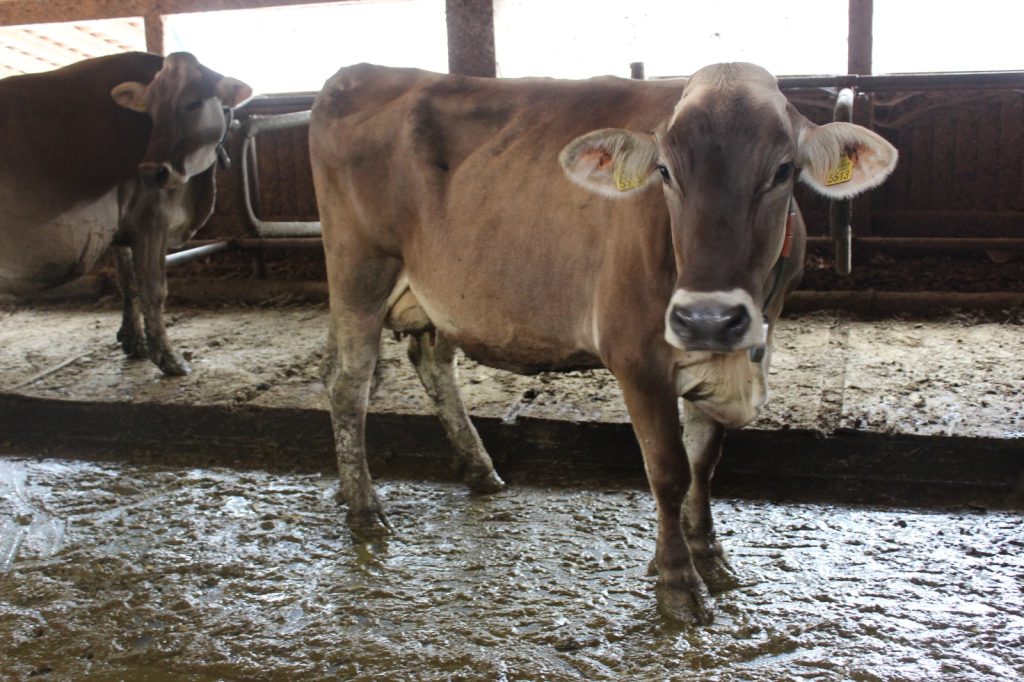
The barn, where the cows pushed against one another, was wet from the liquid running from beneath their tails. The owner explained that he had just run out of dry feed.
He looked deeply exhausted by industrial dairy farming. He had realized that this was not a fulfilling way to live, and so he had decided to greatly reduce his cheese-making business.
He also regretted that the cows were mostly called by numbers, because they did not respond to the names written on their papers. Nor did they know the warmth of human touch.
The farmer told us,
“I simply can’t manage it. Every now and then I pet one of them, but I know that’s not enough. When I was a boy, we had ten cows, and I knew every single one of them.”
Then he showed us the cows that were still for sale.
And that is when a miracle happened.
We had become accustomed to the fact that cows living in such a heartless environment usually did not trust us. Whenever we spoke gently to them and invited them to come to our pastures, they would fearfully pull their heads away whenever we tried to stroke them. We comforted ourselves by thinking that, given enough time and love, everything would eventually change.
Today we understand that it simply had not yet been the right time to bring a cow home.
Through this experience we clearly saw that when Kṛṣṇa gives His approval, there is no room for doubt. He unmistakably reveals that the right time has come and arranges the entire situation.
Kṛṣṇa had sent us Arona—that much was clear.
Even during our phone conversation with the owner, we somehow knew it would be her.
At first he listed all the pregnant cows, but we felt completely uncertain about that choice. Then he asked,
“Would you perhaps be interested in a cow that isn’t pregnant? I have one that hasn’t been able to have a calf for two years. I didn’t mention her because buyers usually aren’t interested in a cow like that…”
Once we met her at the farm, everything became perfectly clear.
Arona was the one.
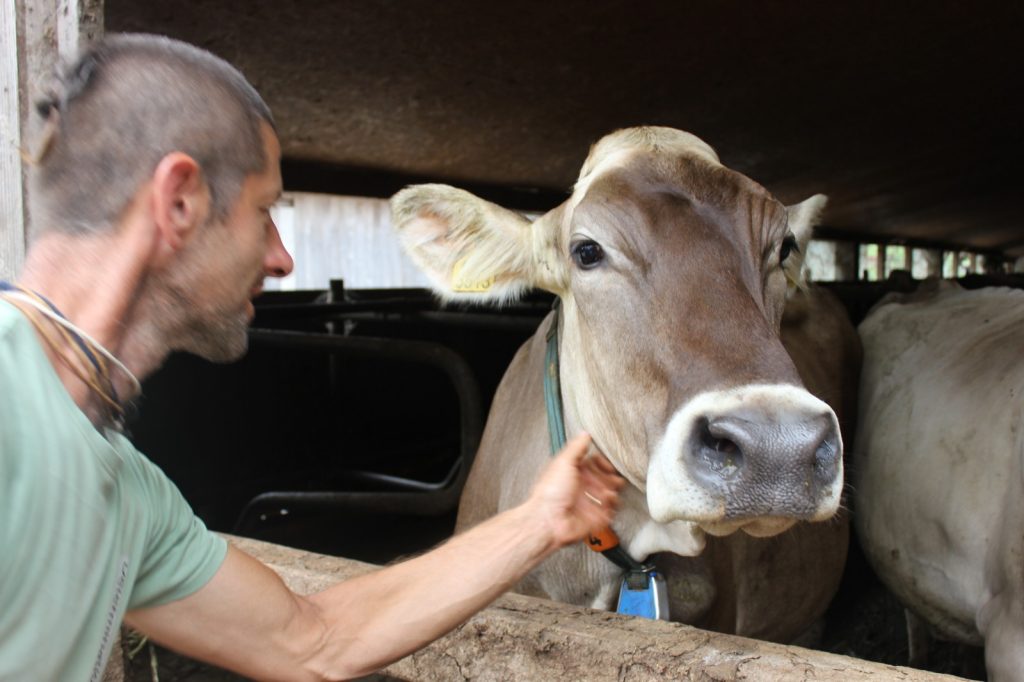
When we stroked her, she did not pull her head away. There was no fear in her eyes. She simply trusted us.
It seemed as though she understood everything we were telling her.
I sang the Mahā-mantra to her and invited her to come to our farm. She was calm and beautiful. She also enjoyed being scratched on the neck, and from that moment on she kept following us wherever we went.
We promised her that we would come back for her.
Antardvip later said that she looked directly into his eyes, and that the moment touched him deeply.
Vidvan spoke to her as well.
“I will wash your feet, dear cow, until they shine like gold. I will place a flower garland around your neck, and I won’t paint your barn white—I will paint it gold!”
“Are you in a hurry to leave?” I asked the owner after we had spent quite some time with the cows.
“Take your time,” he replied. “I’m happy to see that you’ve devoted so much attention to them.”
When we told him that we had chosen Arona, he was genuinely pleased. He admitted that otherwise he would have had to send her to the slaughterhouse in November.
I do not like using such heavy words, but in this case I cannot avoid them, because I deeply appreciate his honesty and his awareness that Arona would be spared such a cruel fate.
As we shook hands to conclude our agreement and said our goodbyes, heavy rain suddenly began to fall.
We understood it as a blessing from heaven.
Our hearts were filled with deep joy.
About ten minutes into our drive home, the car in front of us bore the license plate:
GO 44 PZN
We understood it in the following way:
GO – go means “cow” in Sanskrit.
44 – the number Arona wore around her neck.
PZN – to me it unfolded as: TAKE CARE OF HER.
This was our first meeting with our new cow, during which we unmistakably felt Kṛṣṇa’s personal presence.
To be continued…
Your servants,
Antardvip das
Asta-sakhi Priya Devī Dāsī
Bh. Vidvan